Wednesday, April 1, 2015

Coming SOON - Product Review!

US Tactical Emergency Medicine is taking on a new project-

We wanted to provide others some insight to the gear I've dealt with. So over the next few months, when time permits, I'm going to provide details, specs, likes/dislikes and summary of gear that.

Why would I want to get into this arena? Simply because there are those that are always looking for honest, simple and respectful, non-paid, feedback on gear we use and have availability too. I'm not going to lie, sometimes companies give me samples, and I will talk about that, but that won't change my methodology for the review and who know, might even help them improve.


So please, give us your ideals and thoughts. Tell us what you want to see and we will do our best to get that feedback too you.

In the works-
Tru-spec Combat shirt
VooDoo Tactical Special Operators Bag
5.11 24 Hour Rush Bag
Oakley Radar Glasses

WWW.USTEMS.COM

Warrior Wedensday 04-01

Doolittle's Raiders - Today's Warrior Wedensday, flashback. Honoring Lt. Col. Hite who passed away earlier this week.

Colonel Hite's story (here)

 Graduated from High School in 1937; Completed three years of college and enlisted as an Aviation Cadet on September 9, 1940 at Lubbock, Texas. Commissioned as Second Lieutenant and rated as pilot on May 29, 1941. Was captured after Tokyo Raid and imprisoned by the Japanese for forty months. Liberated by American troops on August 20, 1945, he remained on active duty until September 30, 1947. Returned to active duty during Korean War on March 9, 1951 and served overseas before relief from active duty again in November, 1955. Decorations include the Distinguished Flying Cross, Purple Heart with 1 Oak Leaf Cluster, and Chinese Breast Order of Pao Ting.

The Raiders! Doolittle Raiders
On 18 April 1942, airmen of the US Army Air Forces, led by Lt. Col. James H. (Jimmy) Doolittle, carried the Battle of the Pacific to the heart of the Japanese empire with a surprising and daring raid on military targets at Tokyo, Yokohama, Yokosuka, Nagoya, and Kobe. This heroic attack against these major cities was the result of coordination between the Army Air Forces and the US Navy, which carried the sixteen North American B-25 medium bombers aboard the carrier USS Hornet to within take-off distance of the Japanese Islands. Here, a pair of alert escorts follow the USS Hornet to protect her lethal cargo of B-25 bombers. (U.S. Air Force Photo)

The Mission and the Man
In January 1942, Gen. Henry "Hap" Arnold selected Lt. Col. James Doolittle to lead Special Aviation Project No. 1, the bombing of Japan. Doolittle, who enlisted in the Army in 1917, became a flying cadet and received his commission in 1918. In the late 1920s and the early 1930s, he won the prestigious Schneider, Bendix and Thompson aviation trophies. He made the first blind flight in 1929 during which he took off, flew and landed while being completely dependent upon aircraft instruments. Doolittle left the Army Air Corps in 1930, but when war appeared imminent, in 1940 he returned to active duty. Although the Doolittle Raid of April 18, 1942, caused only minor damage, it forced the Japanese to recall combat forces for home defense, raised fears among the Japanese civilians, and boosted morale among Americans and our Allies abroad.

North American B-25B Mitchell
The B-25 medium bomber was one of America's most famous airplanes of World War II, and more than 9,800 were built. It saw duty in every combat area, being flown by the Dutch, British, Chinese, Russians and Australians in addition to U.S. forces. Although the B-25 was originally intended for level bombing from medium altitudes, Pacific Theater aircrews often used it at low level to attack Japanese airfields and strafe and skip bomb enemy shipping.

The U.S. Army Air Forces chose the B-25 for the Doolittle Raid because it was the only aircraft available with the required range, bomb capacity and short takeoff distance. The B-25Bs and 24 trained volunteer crews came from the 17th Bombardment Group, Pendleton Field, Ore.

The airplane on display at the museum is a B-25D rebuilt by North American to the configuration of a B-25B used on the Tokyo Raid. It was flown to the museum in April 1958.

The Training
The crews selected for the mission received their training at Eglin Field, Fla. Lt. Henry L. Miller, a Navy pilot from Pensacola Naval Station, provided assistance on how to take off within 300 feet, the available distance on the carrier USS Hornet. The crews also practiced cross-country and night flying, navigating without radio references or landmarks, low-level bombing and aerial gunnery. They completed their training in mid-March and later flew to San Francisco to board the carrier.

The Bombsight
Instead of the Norden bombsight, which was ineffective at low altitudes, Capt. C. Ross Greening, pilot and armament officer for Doolittle's group designed a replacement bombsight (seen in the nose of the aircraft). This bombsight was connected to the cockpit through the pilot direction indicator, allowing the bombardier to give the pilot aircraft turn directions without relying on voice communication. Using materials costing 20 cents, the metal working shops at Eglin Field manufactured the bombsights.

The Aircraft Carrier
The newly-built aircraft carrier USS Hornet was chosen to carry Doolittle's B-25s toward Japan. In March it sailed to Alameda Naval Air Station near San Francisco to load the Army Air Forces aircraft, 72 officers and 64 enlisted men. On April 2, 1942, not wanting to sail at night because of an inexperienced crew, the Hornet's captain, Marc A. Mitscher, left for the secret mission in broad daylight.

(SOURCE)

Wednesday, March 11, 2015

Warrior Wednesday 3-11

Today's honor goes to SSG Salvatore Giunta
Giunta is the fourth Medal of Honor recipient from the War in Afghanistan, and the first since Vietnam the others; 
U.S. Navy Lieutenant Michael P. Murphy, U.S. Army Sergeant First Class Jared C. Monti, and U.S. Army Staff Sergeant Robert James Miller, the others being posthumously awarded the medal. All four were decorated for actions in eastern Afghanistan's small but highly-lethal Kunar Province.


Salvatore (”Sal") Augustine Giunta was born in Iowa, the winter of 1985. He is the oldest of three children of Steven, a medical equipment technician, and Rosemary, a pre-school teacher.
Staff Sgt. Giunta was raised in Cedar Rapids and Hiawatha, Iowa. Childhood adventures were in many instances a forerunner of Staff Sgt. Giunta's adult life and experiences in the Army. As a kindergartner, his mother taught him how to remove the screen from his ground-level bedroom window to escape in an emergency, such as a fire. That night, he reportedly packed a suitcase, crawled out the window, and attempted to take advantage of his new-found freedom – but made it only as far as a neighbor's because he did not know where to go. The open window escape route, coupled with sense of adventure, willing to tempt the unknown, and resultant wanderlust, may have inspired his attendance at the U.S. Army Airborne School and military service as a paratrooper.


The Citation:

For conspicuous gallantry and intrepidity at the risk of his life above and beyond the call of duty:
Specialist Salvatore A. Giunta distinguished himself conspicuously by gallantry and intrepidity at the risk of his life above and beyond the call of duty in action with an armed enemy in the Korengal Valley, Afghanistan, on October 25, 2007. While conducting a patrol as team leader with Company B, 2d Battalion (Airborne), 503d Infantry Regiment, Specialist Giunta and his team were navigating through harsh terrain when they were ambushed by a well-armed and well-coordinated insurgent force. While under heavy enemy fire, Specialist Giunta immediately sprinted towards cover and engaged the enemy. Seeing that his squad leader had fallen and believing that he had been injured, Specialist Giunta exposed himself to withering enemy fire and raced towards his squad leader, helped him to cover, and administered medical aid. While administering first aid, enemy fire struck Specialist Giunta’s body armor and his secondary weapon. Without regard to the ongoing fire, Specialist Giunta engaged the enemy before prepping and throwing grenades, using the explosions for cover in order to conceal his position. Attempting to reach additional wounded fellow soldiers who were separated from the squad, Specialist Giunta and his team encountered a barrage of enemy fire that forced them to the ground. The team continued forward and upon reaching the wounded soldiers, Specialist Giunta realized that another soldier was still separated from the element. Specialist Giunta then advanced forward on his own initiative. As he crested the top of a hill, he observed two insurgents carrying away an American soldier. He immediately engaged the enemy, killing one and wounding the other. Upon reaching the wounded soldier, he began to provide medical aid, as his squad caught up and provided security. Specialist Giunta’s unwavering courage, selflessness, and decisive leadership while under extreme enemy fire were integral to his platoon’s ability to defeat an enemy ambush and recover a fellow American soldier from the enemy. Specialist Salvatore A. Giunta’s extraordinary heroism and selflessness above and beyond the call of duty are in keeping with the highest traditions of military service and reflect great credit upon himself, Company B, 2d Battalion (Airborne), 503d Infantry Regiment, and the United States Army.

More on him:
http://www.army.mil/medalofhonor/giunta/

Tuesday, March 3, 2015

Warrior Wednesday 3-4

Today's edition of Warrior Wednesday features one of the most rare feats accomplished by any American Warrior ever. 

Sergeant Major Dan Daly 


His early life is fairly unknown to even those who have studied him, he was born and raise in New York and was small in stature but still known as a fighter and amateur boxer. Born in 1873, he enlisted in the USMC in 1899 and was shipped off to fight in the Spanish-American war but enroute, he was sent back stateside as the war had ended before arrival.

First awarded MOH
Daly was part of the U.S. Embassy Guard in Peking when the Boxer Rebellion broke out in 1900. In one of the most memorable acts of that war, the Boxers surrounded the compound of the foreign legations in Peking and laid siege to it for 55 days. At one point, when German Marines of the German embassy were forced back, Daly by himself took a position in a bastion on the Tarter Wall and remained there throughout the night. Armed wiht only a bolt action rifle and bayonet Subjected to sniper fire and numerous attacks, when relieved in the morning Private Daly was still holding his position with the bodies of numerous attackers surrounding his position attesting to his bravery. (source)

Second awarded MOH
On October 24, Daly was part of a patrol of 35 Marines that was ambushed by about 400 of the bandit Cacos while making its way through a deep ravine. With great effort, the marines fought their way to higher ground and a more defensible position, but while crossing a river under heavy fire, the patrol was forced to abandon several horses, including the one carrying its only machine gun. During the night the patrol was subjected to continuous fire, and the patrol commander called for the machine gun. Daly promptly volunteered to return to the river and retrieve the weapon. Making his way back past enemy positions, Daly located the dead horse (or mule), cut the gun away, strapped it to his back, and returned to the patrol's position. The next morning the patrol broke free in a daring assault on the Caco positions, killing 75 rebels and scattering the rest.  (Source)

Do you want to live forever?
His real heroics were saved until they were needed most. The 44-year-old continued to write his name into the history books during June 1918’s Battle of Belleau Wood, a month-long offensive that was one of the first major World War I battles fought by U.S. troops. On June 5, Daly bravely extinguished a fire on the verge of igniting a cache of explosive ammunition. Two days later, as his Marines were being shredded by enemy machine gun fire, Daly urged them to leave their cover and counterattack by supposedly screaming the famous words, “Come on, you sons of bitches! Do you want to live forever?!”

Daly’s near-suicidal courage was put on display once again on June 10, when he single handedly charged a German machine gun nest, killing its commander and taking 14 prisoners. That same day, he made several trips into “no man’s land” to drag wounded troops to safety. Daley was wounded later that month during a second solo rescue mission, and suffered two more injuries during the Meuse-Argonne offensive in October 1918. 

While he was again recommended for the Medal of Honor for his actions at Belleau Wood, the military balked at the prospect of any soldier receiving the award three times, and he was instead given the Distinguished Service Cross and the French Medaille Militaire. Perhaps the greatest compliment was paid by General Smedley Butler himself a double Medal of Honor winner would later describe Daly as, “the fightingest Marine I ever knew.”  (Source)


First citation:
The President of the United States of America, in the name of Congress, takes pleasure in presenting the Medal of Honor (First Award) to Private Daniel Joseph Daly (MCSN: 73086), United States Marine Corps, for extraordinary heroism while serving with the Captain Newt Hall's Marine Detachment, 1st Regiment (Marines), in action in the presence of the enemy during the battle of Peking, China, 14 August 1900, Daly distinguished himself by meritorious conduct.

Second Citation:
The President of the United States of America, in the name of Congress, takes pleasure in presenting the Medal of Honor (Second Award) to Gunnery Sergeant Daniel Joseph Daly (MCSN: 73086), United States Marine Corps, for extraordinary heroism in action while serving with the 15th Company of Marines (Mounted), 2d Marine Regiment, on 22 October 1915. Gunnery Sergeant Daly was one of the company to leave Fort Liberte, Haiti, for a six-day reconnaissance. After dark on the evening of 24 October, while crossing the river in a deep ravine, the detachment was suddenly fired upon from three sides by about 400 Cacos concealed in bushes about 100 yards from the fort. The Marine detachment fought its way forward to a good position, which it maintained during the night, although subjected to a continuous fire from the Cacos. At daybreak the Marines, in three squads, advanced in three different directions, surprising and scattering the Cacos in all directions. Gunnery Sergeant Daly fought with exceptional gallantry against heavy odds throughout this action.

Full list of citations for valor:
http://projects.militarytimes.com/citations-medals-awards/recipient.php?recipientid=571


Wednesday, February 25, 2015

Warrior Wednesday 2-25

Today's edition of Warrior Wednesday is a special one, for a special breed of man who gives much more than he ever asks for.
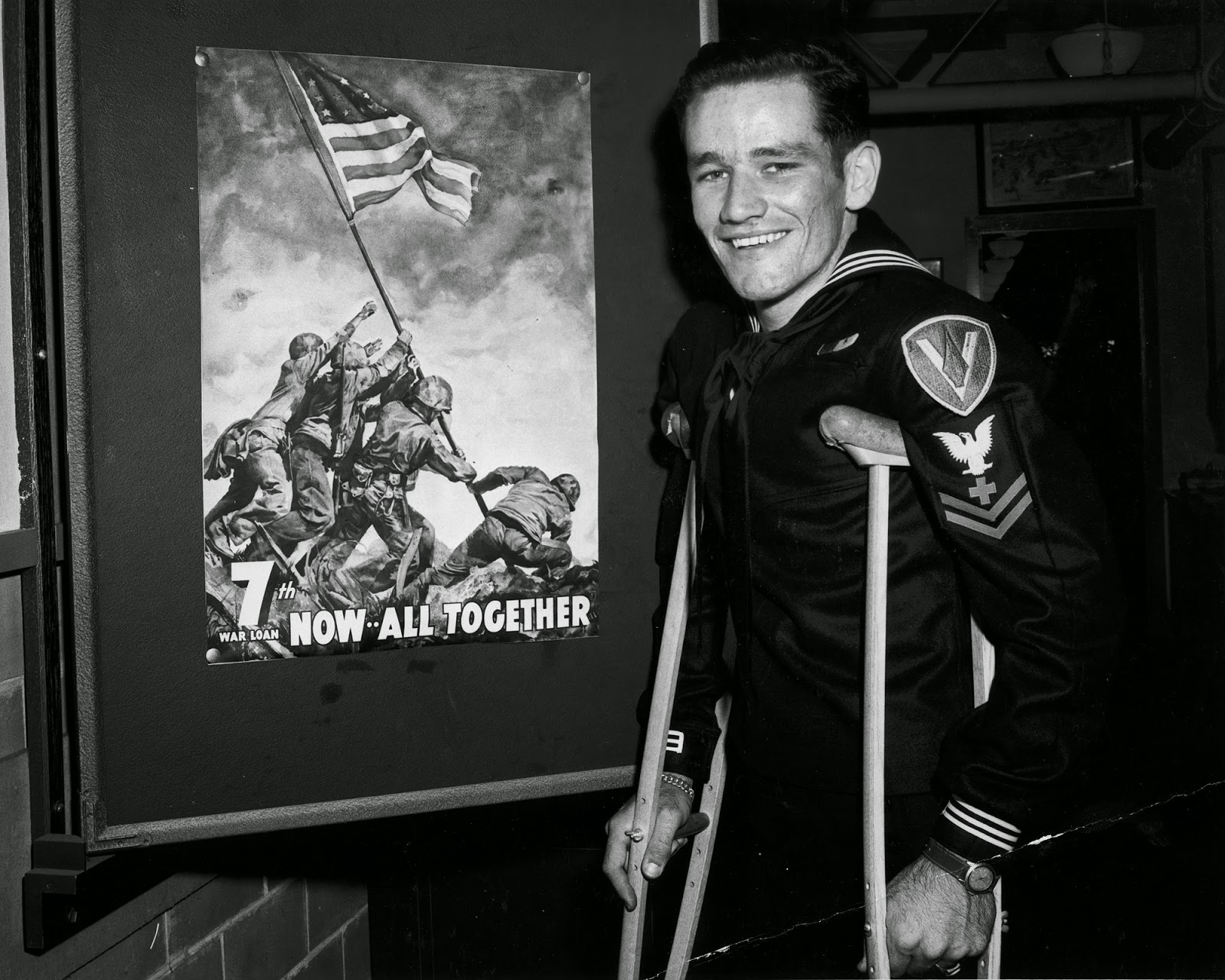
This week's honor goes to "doc" John Bradley. Doc fought in the battle of Iwo Jima, was one of six who helped raise the flag on Mount Suribachi, handled over 200 wounded or dying Marines, lost his best friend in the battle who wasn't just killed, he was captured, tortured, mutilated and then killed.
He was the recipient of the Navy Cross (the Nations second highest award for valor), the purple heart and Presidential Unit Citation.

After the battle:
Doc toured the US with the other survivors who raised the flag on a bond raising tour. They collected over $26 Billion towards the war effort.
Doc gave only 1 interview after the war, married his childhood sweetheart, played himself in John Wayne's "Sands of Iwo Jima" along with the other two survivors. And passed away at the age of 70. He was the oldest and last remaining member of the flag raisers. His son was the person who wrote the book which eventually became "The Flags of our Fathers".

His citation for the Navy Cross:


For extraordinary heroism in action against the enemy at Iwo Jima on Feb. 21, 1945 as a hospital corpsman attached to a Marine Rifle platoon. During a furious assault by his company upon a strongly defended enemy zone at the base of Mt. Suribachi, Bradley observed a Marine infantryman fall wounded in an open area under a pounding barrage by mortars, interlaced with a merciless crossfire from Machine guns.
With complete disregard for his own safety, he ran through the intense fire to the side of the fallen Marine, examined his wounds and ascertained that an immediate administration of plasma was necessary to save the man's life. Unwilling to subject any of his comrades to the danger to which he had so valiantly exposed himself, he signaled would-be assistants to remain where they were. Placing himself in a position to shield the wounded man, he tied a plasma unit to a rifle planted upright in the sand and continued his life saving mission.
The Marine's wounds bandaged and the condition of shock relieved by plasma, Bradley pulled the man thirty yards through intense enemy fire to a position of safety. His indomitable spirit, dauntless initiative, and heroic devotion to duty were an inspiration to those with who he served and were in keeping with the highest tradition of the United States Naval Service.

Wednesday, February 18, 2015

Warrior Wednesday

Every Wednesday, our facebook page picks a highly deserving Warrior to feature. Please check every week to see who's incredible story we share.

This week, 18 Feb. 2015 we are honored to share the story of U.S. Marine Corps Cpl. Jason Dunham. His citation reads as follows:

"The President of the United States in the name of The Congress takes pride in presenting the Medal of Honor posthumously to:


CORPORAL
JASON L. DUNHAM
UNITED STATES MARINE CORPS 


For service as set forth in the following citation: (source)
For conspicuous gallantry and intrepidity at the risk of his life above and beyond the call of duty while serving as Rifle Squad Leader, 4th Platoon, Company K, Third Battalion, Seventh Marines (Reinforced), Regimental Combat Team 7, First Marine Division (Reinforced), on 14 April 2004. Corporal Dunham's squad was conducting a reconnaissance mission in the town of Karabilah, Iraq, when they heard rocket-propelled grenade and small arms fire erupt approximately two kilometers to the west. Corporal Dunham led his Combined Anti-Armor Team towards the engagement to provide fire support to their Battalion Commander's convoy, which had been ambushed as it was traveling to Camp Husaybah. As Corporal Dunham and his Marines advanced, they quickly began to receive enemy fire. Corporal Dunham ordered his squad to dismount their vehicles and led one of his fire teams on foot several blocks south of the ambushed convoy. Discovering seven Iraqi vehicles in a column attempting to depart, Corporal Dunham and his team stopped the vehicles to search them for weapons. As they approached the vehicles, an insurgent leaped out and attacked Corporal Dunham. Corporal Dunham wrestled the insurgent to the ground and in the ensuing struggle saw the insurgent release a grenade. Corporal Dunham immediately alerted his fellow Marines to the threat. Aware of the imminent danger and without hesitation, Corporal Dunham covered the grenade with his helmet and body, bearing the brunt of the explosion and shielding his Marines from the blast. In an ultimate and selfless act of bravery in which he was mortally wounded, he saved the lives of at least two fellow Marines. By his undaunted courage, intrepid fighting spirit, and unwavering devotion to duty, Corporal Dunham gallantly gave his life for his country, thereby reflecting great credit upon himself and upholding the highest traditions of the Marine Corps and the United States Naval Service".
Here is how to learn more about Cpl. Dunham and his incredible story by going to his page. Cpl. Dunham's page.

RIP Brave Warrior!


What a start!

Our BIO:


This site is BROUGHT TO YOU BY A VETERAN OWNED AND OPERATED MAN WHO HAS DEDICATED HIS LIFE TO SERVICE OF HIS COUNTRY AND NEIGHBORS. RON SERVED IN THE US NAVY ABOARD THE U.S.S TARAWA DURING OPERATION DESERT SHIELD/STORM AND SOMOLIA. AFTER GETTING OUT HE WORKED IN SALES AND STUDIED BOTH FIRE SCIENCE AND EMERGENCY MEDICINE. HE HAS SPENT 12 YEARS AS AN EMERGENCY MEDICAL PROVIDER (PARAMEDIC ). OVER 8 YEARS OF THAT WAS AS A FIRE FIGHTER.
HE HAS WORKED IN THE DOWNRIVER AREA'S, DETROIT AND DEARBORN. RON CURRENTLY HOLDS THE RANK OF SSG (E-6) IN THE MIVDF (MICHIGAN DEFENSE FORCE)
CERTIFIED IN: TCCC, PHTLS, ACLS, PALS, AHA CPR, AND IN CERT TRAIN THE TRAINER. WITH OVER 100 HOURS DEDICATED THIS YEAR TO CONTINUING EDUCATION TO PERFECTING THE COURSE CURRICULUM THAT IS BEING TAUGHT TO EACH AND EVERY STUDENT WHO WANTS TO LEARN THE LATEST IN TACTICAL MEDICINE.